

Open vs. Closed-Cut Valleys: How Shingle Valleys Are Built and Why It Matters for Peachtree City Leaks
Valleys carry more rainwater than any other part of a roof, and small build details decide whether they leak.
Schedule a free inspection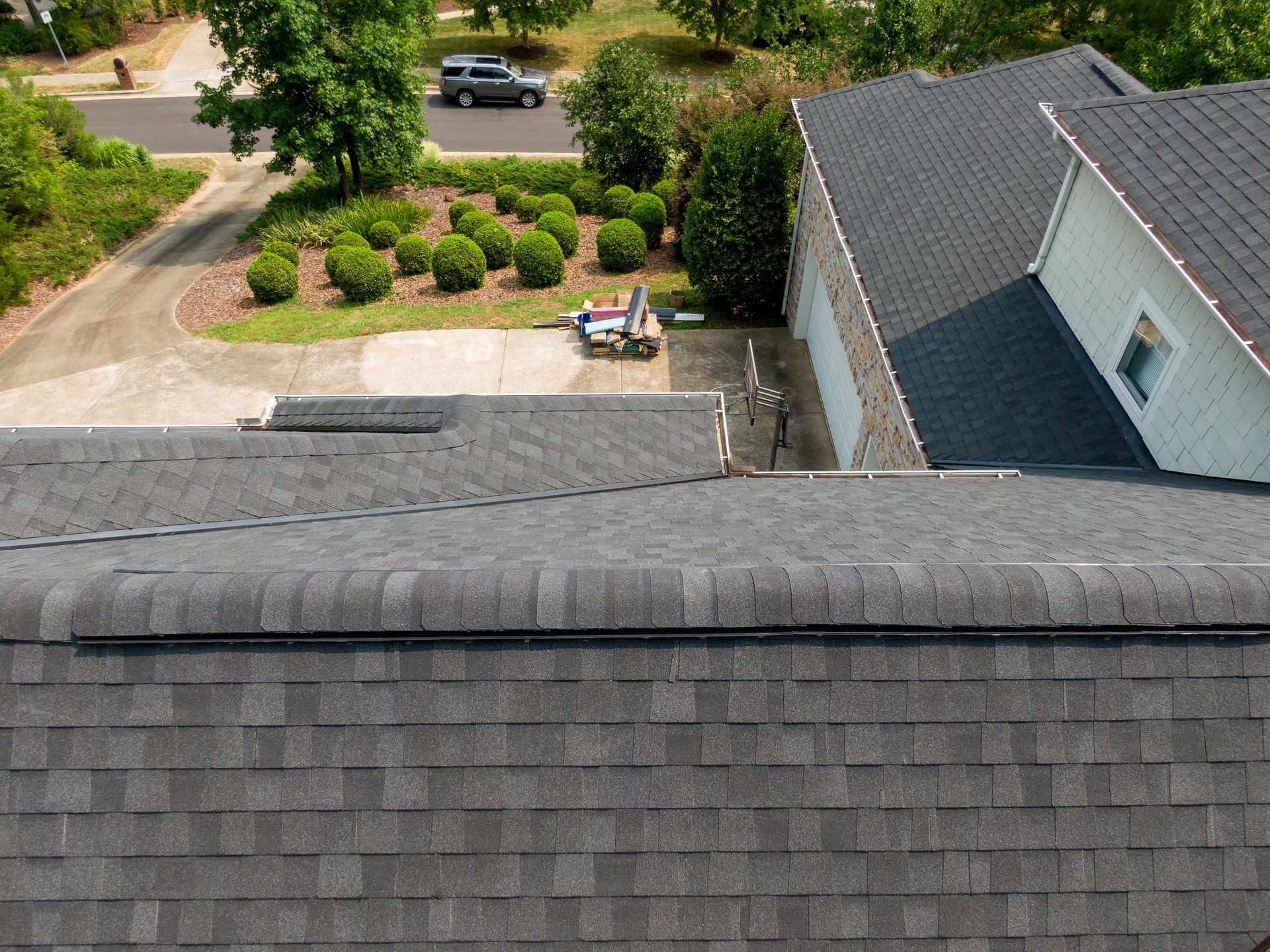
An open valley leaves a strip of metal flashing exposed down the center where two roof slopes meet. A closed-cut valley runs shingles from one slope across the center and trims the other slope's shingles in a straight line set back from the middle. Both styles can keep water out for the life of the roof, and when one leaks, the cause is almost always in how it was built.
Valleys handle more water than any other part of a shingle roof. Rain from two slopes funnels into one narrow channel and races toward the gutter. On a Peachtree City home with tall pines overhead, that channel also collects needles and leaves, which slow the water down and hold it against the shingles.
That's why a valley that looked fine for years can suddenly drip into a bedroom closet after one heavy summer downpour.
In this guide
How Each Valley Style Is Put Together
Every valley starts with underlayment, the waterproof layer that goes on the wood deck before any shingles. In valleys, roofers often use a self-adhering membrane that seals around nails. What goes on top of that layer is where the two styles split.
Open valleys
In an open valley, a strip of metal flashing (bent sheet metal that sheds water) runs the full length of the valley. Shingles from both slopes stop short of the center, so the metal shows. Water rides down the smooth metal rather than across shingle edges, and the shingle edges along the metal are trimmed and sealed so water can't curl back underneath them.
Closed-cut valleys
In a closed-cut valley, shingles from one slope are laid across the valley and up the opposite side. Shingles from the other slope go on top and are cut in a clean line set back slightly from the center. The upper corner of each cut shingle is clipped and stuck down so water can't slip sideways under it. No metal shows, so the valley blends into the rest of the roof.
Some older homes have woven valleys instead, where shingles from both sides interlace across the center like a braid. They're less common now but work on the same idea as a closed valley.
Which Valley Style Fits Which Roof?
Neither style wins on every house. The better pick depends on how much water the valley carries, what lands in it, and how the roof looks from the street.
Where an open valley makes sense
- Long valleys that drain two large slopes and carry heavy flow in a storm
- Roofs under trees, since needles and leaves slide off smooth metal more easily than off shingle edges
- Homes where the owner likes the look of a defined metal line
Where a closed-cut valley makes sense
- Most standard shingle roofs, where a clean, uniform look matters
- Shorter valleys with moderate water flow
- Houses where an exposed metal strip would clash with the shingle color
Each style has its own weak points. Open valleys depend on metal of the right width and shingle edges trimmed cleanly along it. Closed-cut valleys depend on the cut line staying off center and on keeping nails well away from the middle, where the water travels. On asphalt shingle roofs, either one holds up when those details are right.
Why Valleys Leak, Whichever Style You Have
Valley leaks almost always trace back to a short list of build or maintenance problems.
- Nails too close to the center. A nail near the middle of a valley sits right in the path of the heaviest water. Once the shingle over it wears, water follows the nail into the deck.
- A cut line in the wrong spot. If cut shingles end right at the center, water can run along the cut edge and slip underneath instead of flowing down the channel.
- Skipped corner clips. On a closed-cut valley, the top corner of each cut shingle needs trimming and sealing. Skip it, and water turns sideways under the shingle.
- Debris dams. Pine straw and leaves pile up where a valley meets a wall, a dormer, or the roof edge. Water backs up behind the pile and climbs under shingle edges.
- Overflow at the valley outlet. A valley dumps a concentrated stream into one section of the gutter system. If that spot can't keep up, water spills over the back and soaks the fascia board behind it.
Indoors, valley leaks tend to show as stains along an inside ceiling corner, at the top of a closet wall, or in the attic along the line where two roof planes meet. A slow valley leak can soften decking for months before paint ever stains. The good news is that a targeted valley repair is often possible without touching the rest of the roof.
What Bald Eagle Roofs & Exteriors Brings to Valley Work
Valleys are where installation shortcuts show up first, so workmanship counts here more than almost anywhere else on a roof. Bald Eagle Roofs & Exteriors backs its installation work with a 5-year workmanship warranty, which gives you recourse on the install itself if a valley built during that work gives you trouble.
The company uses materials from trusted suppliers, including Gulfeagle, Atlas, and TAMKO. A valley only works when every layer does its job, from what goes on the deck to the shingles on top, so dependable materials give the build a sound starting point.
Pine Straw, Summer Downpours, and Roof Valleys
Peachtree City has a heavy tree canopy, and many lots carry tall pines that shed needles all year. Those needles collect in valleys faster than most homeowners expect, especially where a valley ends against a wall or above a gutter corner.
Summer brings short, heavy afternoon thunderstorms. A valley draining two broad slopes can carry a surprising amount of water in a few minutes, and any debris dam or tight cut line gets tested hard. Spring storms add wind that pushes rain sideways under shingle edges along the valley.
Local homes run from older two-story houses with busy rooflines to newer builds with several gables and dormers. More roof planes mean more valleys, and each one is a spot where water concentrates. A house with six or eight valleys is worth a quick look along each one after the fall leaf drop.
Have a Valley Checked Before the Deck Softens
If you've found a stain along an inside ceiling corner, or watched water sheet over the gutter below a valley, get it looked at while the decking is still solid. In Peachtree City, Bald Eagle Roofs & Exteriors will check each valley on your roof and explain in plain terms what it finds. Call (706) 803-2253 or book a free roof inspection to get started.
Roof Valley Questions
Can a closed-cut valley be converted to an open valley?
Yes, during a reroof or a valley rebuild. The shingles along the valley come off, the underlayment is checked or replaced, metal flashing goes down the center, and new shingles are trimmed back along both sides. It's usually done when a closed valley keeps clogging with debris or carries more water than it handles well. It isn't something to lay over existing shingles.
How do I know which valley style my roof has?
Look at the valley from the ground or from a window that faces it. A strip of metal running down the center means an open valley. Shingles from one side crossing the center, with the other side ending in a straight cut line, mean a closed-cut valley. Shingles from both sides interlacing like a braid mean a woven valley.
Should I clear pine needles out of my valleys myself?
Clearing what you can reach from the ground or from an open window is fine. Climbing onto a pitched roof isn't, since valleys are often the slickest spots on the roof, especially when needles are damp. Shingles scuff easily too. Many homeowners pair valley clearing with fall gutter cleaning so both jobs happen at the same time.
Does the metal in an open valley rust?
Valley flashing is usually galvanized steel, aluminum, or a coated metal chosen to resist corrosion. It can still wear over many years, especially where wet debris sits on it for long stretches. Rust spots, pinholes, or loose seams along the metal are signs it needs attention. Keeping the valley clear of leaves helps the metal last much longer.
Why does my valley leak only in heavy storms?
Light rain moves down a valley without trouble, but a downpour fills the channel and pushes water toward its edges. If nails sit too close to the center, a cut line is off, or debris is backing water up, that extra volume finds the weak spot. Wind adds sideways pressure too, which is why some valley leaks appear only a few times a year.
Can one valley be repaired without replacing the whole roof?
Often it can. A roofer can remove the shingles along the valley, fix the underlayment and any damaged decking, and rebuild the valley with new shingles or flashing. Matching color on an older roof can be tricky, since shingles fade over time. If the rest of the roof is near the end of its life, a full replacement may make more sense.
Keep Your Valleys Draining Clean
We can check each valley for nail placement, cut lines, debris dams, and gutter overflow, then tell you what needs fixing and what can wait. Call (706) 803-2253 or contact us online.
Schedule a free inspection